
The “Don’t Bend” Trap: Why Avoiding Back Bending Can Keep You Stuck
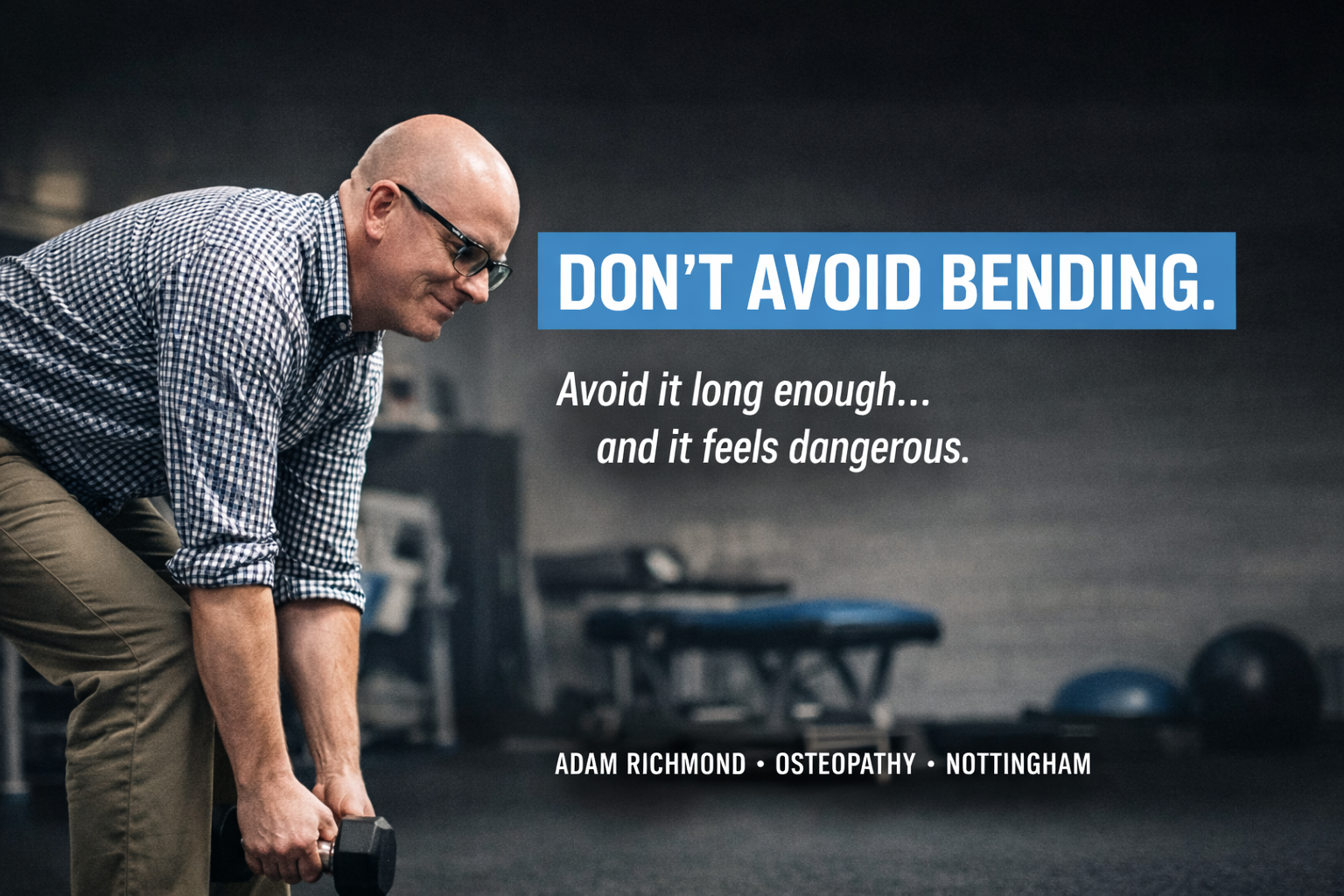
If you’ve had back pain for a while, there’s a really common pattern I see in clinic:
You start protecting your back.
You stop bending. You hinge like a robot. You brace for everything. You avoid the movements that involve flexion. You try to keep a perfectly straight back when you pick anything up — even a sock, never mind a dumbbell.
It feels sensible at first. And to be fair, it often does reduce symptoms in the short term.
But here’s the trap: if you practise never bending, your back gets less used to bending. And bending is one of the most normal human movements there is.
So when real life eventually forces it — picking up a child, reaching into the car, gardening, tying your shoes, loading the dishwasher — you’re more likely to get a flare-up.
I’m Adam Richmond, an osteopath in Nottingham, and I see this “don’t bend” trap regularly. People accidentally train their body to treat a normal movement like it’s dangerous.
This post will explain why it happens, why it can make you more vulnerable, and what I do to help you rebuild bending gradually so you can start to move more naturally again.
Bending is inevitable (even if you do everything “right”)
You can avoid bending in the gym for a while. You can avoid it at work for a while. You can avoid it in day-to-day life for a while.
But unless you plan to live like a forklift truck, you can’t eliminate spinal bending from a normal life.
And that matters because your body adapts to what you repeatedly do.
If you practise bending often (in sensible doses), you generally become more confident and tolerant of it.
If you practise avoiding bending for months or years, bending starts to feel unfamiliar… and unfamiliar movements often feel threatening — especially when you’ve had pain before.
This is one reason people tell me:
“It’s fine most of the time… but when I forget and bend, it goes.”
It’s not that bending is “bad”. It’s that bending has become the unexpected event your system isn’t prepared for.
Where does this fear come from?
A big chunk of it is fear-conditioning after an episode of pain — which is totally human.
But there’s another factor I think feeds it: the way health and safety messaging has been drilled into people for decades.
“Keep a straight back when lifting”
Most of us grew up hearing that a “rounded back” is dangerous and that the safe way to lift is with a rigid straight spine.
The problem is: there isn’t good evidence that keeping a straight back prevents back injury. Real-world research shows something more nuanced:
- Some people naturally prefer lifting with a more upright, straighter back.
- Some people naturally prefer a more bent-back style.
- Injury risk doesn’t magically disappear because someone looks “perfect”.
- And importantly: injury rates can go up when you force people to lift in a way they’re not used to.
So if you’ve always lifted a certain way, then you suddenly change everything because you’re scared (or because someone told you you “must”), you can actually make lifting feel harder, stiffer, and more threatening.
Pain doesn’t always mean damage
This part is important.
Back pain is real. It can be intense. It can stop you sleeping. It can ruin your mood. But pain is not a direct measure of damage.
A sensitive back can be sore with normal movement — especially when you’ve been guarding it, bracing it, and avoiding certain positions.
In osteopathy, my job isn’t to “put you back in” or convince you your spine is fragile. It’s the opposite:
To help you feel safe moving again.
What I do in clinic: rebuild bending in tiny doses
When someone tells me they’re not able to bend, I don’t start by saying “Just bend more.”
That’s not helpful. And it’s not realistic when your system is already on high alert.
Instead, we work like this:
1) Identify your “currently safe” starting point
There’s nearly always some amount of bending you can tolerate — even if it’s small.
It might be:
- bending a little with hands on thighs
- a gentle “hinge” to mid-shin
- a supported bend holding onto something, or from a seated position
- a slow, controlled movement rather than a fast one
2) Practise that dose until it feels boring
Boring is good. Boring means your brain has stopped treating it like a threat.
3) Build it up gradually (range, load, speed, repetition)
Then we progress.
A bit deeper. A bit more load. A more real-life version.
You’re not trying to be reckless — you’re teaching your back:
“This is normal. This is safe. We can handle it.”
4) Make it look like real life
The end goal isn’t “perfect form”.
The end goal is natural movement, confidence, and a back that doesn’t feel like it needs constant protecting.
That might include training:
- bending to pick things up
- lifting shopping bags
- gym movements (like deadlift patterns) at appropriate loads
- twisting and reaching without panic
In other words: the stuff you actually need.
The big mindset shift: resilience beats protection
If your strategy is “never bend”, you’re relying on avoidance.
Avoidance works until it doesn’t.
A better strategy is resilience:
- expose your back to bending in small, manageable doses
- adapt over time
- return to normal movement without fear running the show
It’s the same principle you’d use for any physical capacity:
If you never practise it, you don’t build it.
“But I bent and hurt myself — doesn’t that prove bending is dangerous?”
Not necessarily.
If bending has been avoided for months, then a sudden bend (especially if it’s awkward, tired, or loaded) can be a perfect storm.
That doesn’t mean bending is inherently harmful. It means your system wasn’t prepared for that dose of bending in that context.
That’s why graded exposure works: it closes the gap between “I avoid this” and “life demands this”.
I wish I could give you a simple takeaway you can use today
Unfortunately, everybody is different, so I can’t offer advice over the internet that’s likely to help you.
This is why I use long appointment slots, so I can assess you properly and understand exactly what you’re doing.
By doing that, many of my clients have a “light bulb” moment — they spot something they’ve been doing that’s been missed by every doctor and practitioner they’ve seen previously. Suddenly they can make a big step towards unlocking their natural movement and, importantly, their confidence in their movement.
How osteopathy can help (Nottingham)
As an osteopath in Nottingham, I combine:
- a very thorough case history and physical assessment, where I leave no stone unturned in trying to learn why you are suffering
- hands-on treatment when it’s useful (to settle symptoms and reduce guarding)
- clear explanations (so you’re not guessing or catastrophising)
- a practical plan that I develop specifically for you — not generic exercises
If your back has started dictating what you can and can’t do, we’ll work towards getting you back to normal life — including bending — in a sensible, progressive way.
Book an appointment
Click here to book an appointment.
Final thought
If you take one thing from this, let it be this:
Avoiding bending doesn’t protect your back long-term.
It often trains your back to be less tolerant of the exact movement life requires.
You don’t need a “perfect spine”. You need a capable one.
And capability is built — gradually, confidently, and in ways that match your real life.
Leave a Reply