
Pain Does Not Automatically Mean Damage
Pain is always real. If you’re hurting, something meaningful is going on.
One of the most important things I’ve learned in practice is this: pain does not always mean damage. And the level of pain rarely matches the level of physical damage.
That idea isn’t always intuitive. But once people get their head around it, it often makes a significant difference to how they understand their symptoms — and how hopeful they feel about improving.
Why pain and damage get mixed up
Most people grow up with a simple model of pain: something is broken, so it hurts. Like a warning light on a dashboard.
Sometimes that model is accurate. A fracture, infection, or serious injury usually does involve clear tissue damage.
But a large proportion of the people I see — particularly those with ongoing back, neck, or joint pain — don’t fit that pattern.
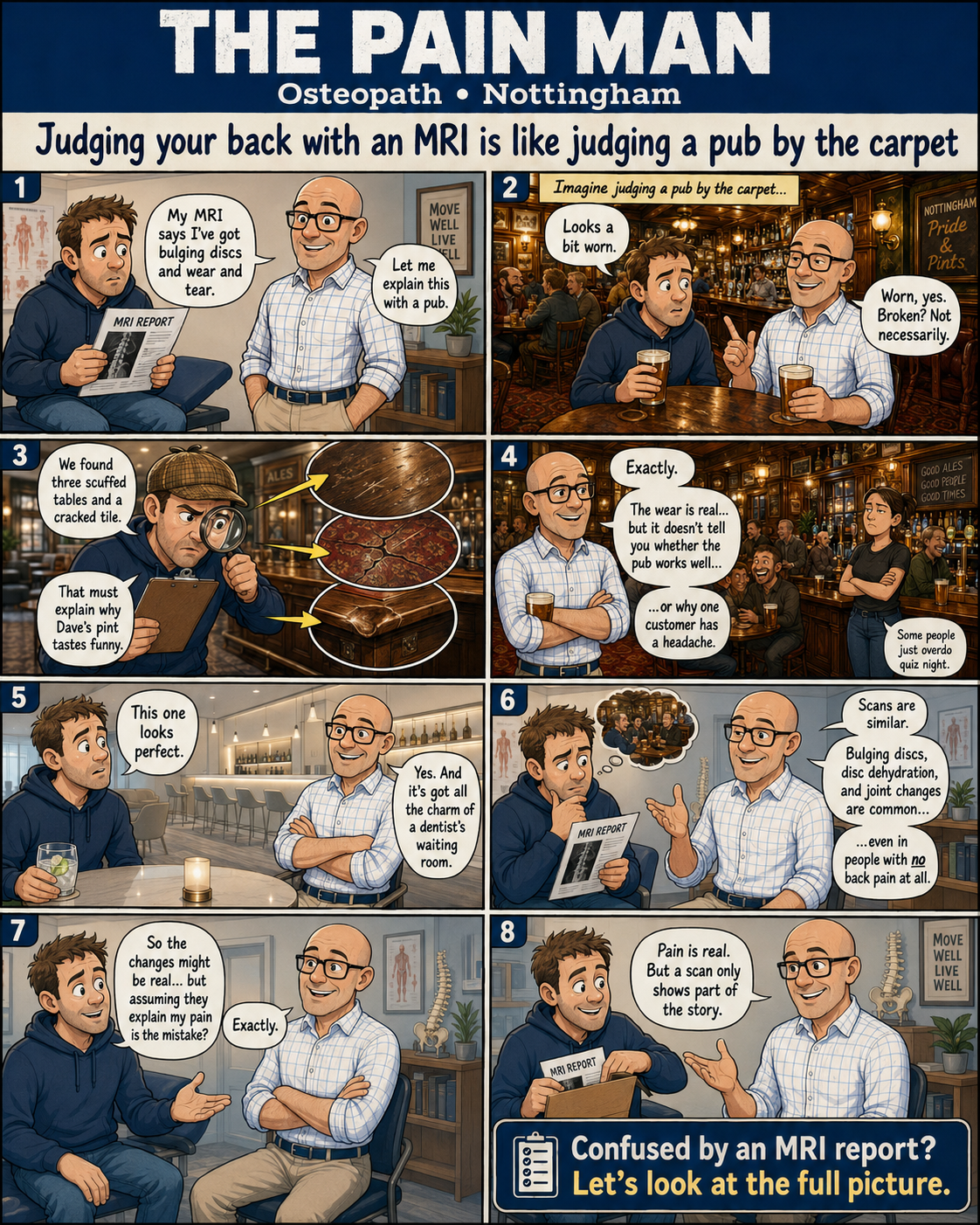
Much of the confusion starts with scans.
What scans really show (and what they don’t)
MRI and X‑ray scans are excellent at showing structure. They are much less good at explaining symptoms.
It’s very common for scan reports to include findings such as:
- Disc bulges or protrusions
- Degeneration or “wear and tear”
- Arthritis
- Reduced disc height
The language alone can sound alarming, especially when you’re already in pain.
Here’s the key point: many of these findings are normal features of being human.
“Wear and tear” is not a disease. It’s more like grey hair or wrinkles — expected changes that come with time. As people get older, these features become more common whether they have pain or not.
There’s an entire industry built around denying this reality, but in clinical practice it’s usually more helpful to call things what they are. Treating normal age‑related change as damage often creates more problems than it solves.
Take disc bulges as an example. They are extremely common. By the age of 40, most people will have at least one disc bulge on a scan — even if they’ve never had back pain.
They increase with age and often have little relationship to how someone feels or functions.
In practice, I regularly see people with very “messy” scans who move well and cope fine — and others with minimal findings who are in significant pain.
Scans are useful tools. They help rule out serious problems. But they don’t tell the whole story. In many cases, their greatest value is reassurance: confirmation that what’s showing up is normal, even when terms like disc bulge or arthritis sound worrying.
Why pain can exist without clear damage
Pain is produced by the nervous system. Its job is protection, not accuracy.
When pain persists, that system can become more sensitive. Things that were once safe start to feel threatening. Movements that should be normal begin to hurt.
This doesn’t mean pain is imagined or “all in your head”. It means the protective system is doing its job a little too well.
Stress, uncertainty, previous injury, fear, sleep, workload, and past advice all feed into this process.
Once pain has been around for a while, it often becomes less about tissue damage and more about sensitivity and protection.
What I see repeatedly in practice
A familiar pattern:
- Someone develops pain, often without a clear injury
- A scan shows “abnormalities”
- They’re advised to be careful, avoid bending, or protect the area
- Movement reduces, confidence drops, pain persists
The intention is always good. But over time, this approach can reinforce fear and stiffness rather than recovery.
When people start to understand that pain doesn’t always equal harm, something shifts. Movement becomes less threatening. Confidence improves. Progress becomes possible.
What this means if you’re in pain
First: your pain matters. It deserves to be taken seriously.
Second: pain does not mean you are fragile, broken, or one wrong move away from disaster.
For many people, improvement comes from gradually rebuilding trust in movement, strength, and normal activity — not from endless protection.
That process is individual. It should be paced, sensible, and guided — not forced.
Where osteopathy fits (and where it doesn’t)
My role isn’t to “fix” damaged structures or chase perfect alignment.
It’s to:
- Help you understand what your pain likely represents
- Reduce unnecessary fear
- Support confidence and normal movement returning safely
- Work with your body, not against it
Sometimes hands‑on treatment helps. Sometimes advice and reassurance matter more. Often it’s a combination.
What matters most is that the plan makes sense to you.
A final thought
Pain is complex. That can be frustrating — but it’s also hopeful.
If pain always meant damage, long‑term pain would be a life sentence. In reality, many people improve once the system is better understood and guided.
Pain is real. Damage is sometimes present. The two are not the same thing.