
What Actually Happens When Your Back Clicks?
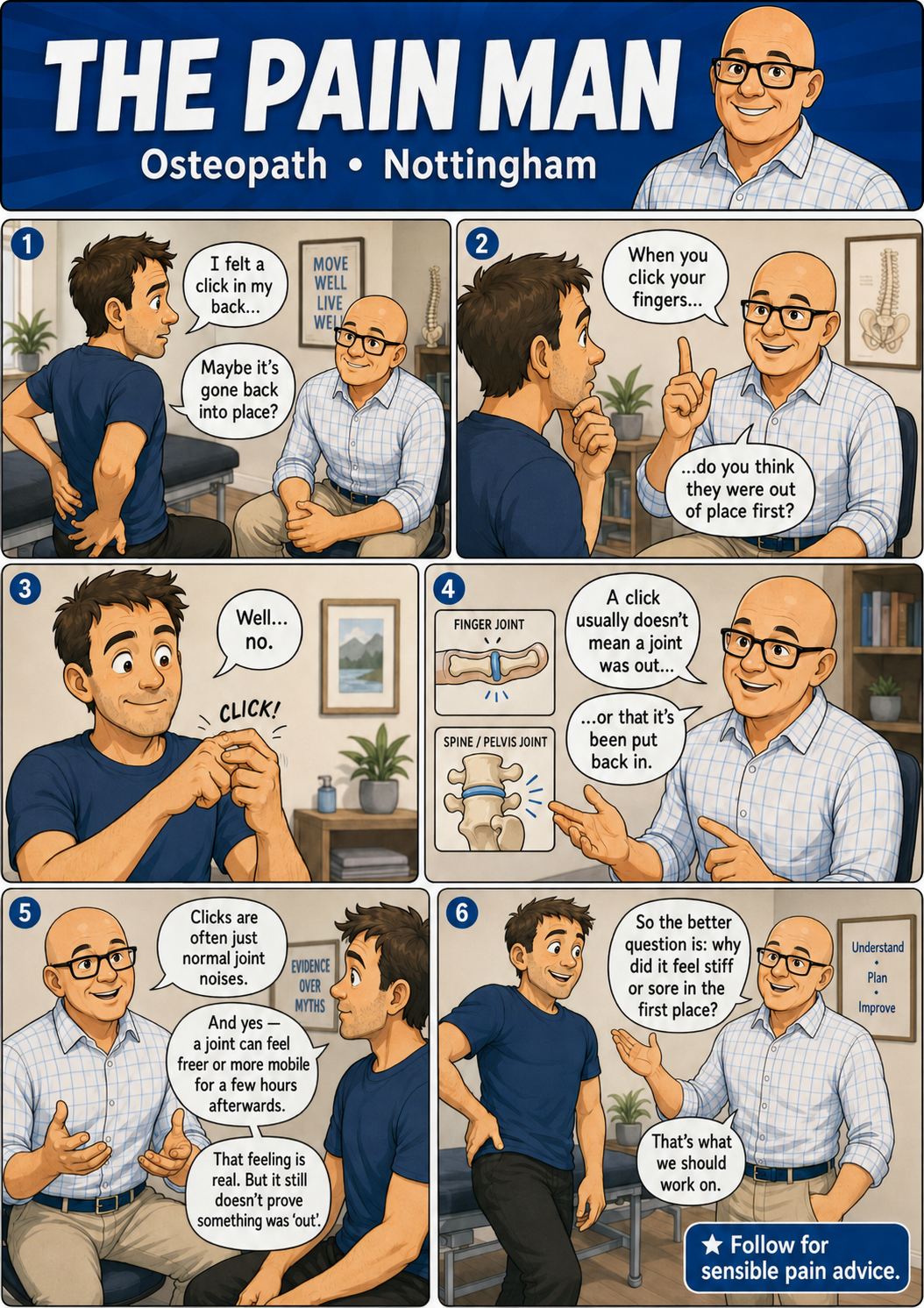
You move, stretch, twist — click.
And suddenly your back feels freer.
It’s very tempting to describe that as something having been “out of place” and then clicking back into place. I hear versions of that explanation all the time in clinic.
I don’t particularly think people are wrong when they say it. “Out of place” is usually just everyday language for something didn’t feel right. Perhaps it felt stiff, uncomfortable, restricted or simply as though it needed to move.
The problem is that “out of place” doesn’t really tell us what was going on.
And the click itself doesn’t tell us either.
A click can feel fantastic
First, I’m not going to try to convince you that nothing happened.
If your back clicks and immediately feels easier to move, then as far as you’re concerned, something absolutely has happened. Your experience has changed.
Sometimes people get a surprisingly big improvement from one very small movement. That can actually be quite reassuring.
You haven’t had torn tissue magically repaired. Nobody has shoved a wandering vertebra back into its allotted parking space. Yet something that felt stiff and uncomfortable a moment ago can suddenly feel much easier.
That tells us something useful: how you feel can change quite quickly without there needing to have been a major structural problem that required correcting.
What it doesn’t tell us is exactly why you felt stiff in the first place.
That is the more interesting question.
So what makes a joint click?
Many of the joints in your body are synovial joints. That includes the joints in your fingers and the small facet joints at the back of your spine.
Their joint surfaces are covered in smooth articular cartilage and the joint contains synovial fluid, which helps the surfaces move against one another.
I’ve often explained this to patients by asking them to imagine two very smooth pieces of glass with some fluid between them. If the surfaces are closely opposed, they initially resist being pulled apart.
That analogy turns out to be reasonably useful — although while checking the research for this article I discovered that one part of the explanation I’ve traditionally given patients needed updating.
Research using real-time MRI has allowed scientists to watch a knuckle actually crack. As the joint surfaces are pulled apart, they initially resist separation. Once enough force is applied, they separate rapidly, pressure within the joint falls and a gas-filled cavity forms in the joint fluid.
The technical term is tribonucleation.
Rather wonderfully, researchers actually put somebody in an MRI scanner and watched this happen rather than simply continuing to argue about it.
The important bit is that the crack appears to be associated with the formation of the cavity, rather than an existing bubble simply bursting.
So yes, there is a genuine physical event occurring inside the joint.
But that is very different from a bone being put back where it belongs.
“Out of place” can send us down the wrong road
This is where language matters.
If somebody tells me their back feels “out of place”, I’m not interested in correcting their vocabulary. I want to know what they mean.
Does it hurt?
Does it feel stiff?
Is a particular movement difficult?
Has it happened before?
Did anything bring it on?
What else is going on?
Those questions give me far more useful information than taking the phrase “out of place” literally.
A normal joint cavitation is also a completely different sort of event from the reduction of a genuinely dislocated joint. We shouldn’t confuse the familiar pop of a knuckle or spinal joint with the much more substantial injury involved when a joint has actually dislocated.
So when a back clicks during treatment, I don’t regard the noise as proof that I have relocated something.
And importantly, neither should the absence of a click mean that treatment has somehow failed.
You don’t actually need the pop
There is research looking specifically at whether getting an audible pop during spinal manipulation improves the result.
A 2022 systematic review looked at studies comparing manipulation that produced an audible pop with manipulation that didn’t. It found no evidence that the pop itself produced better pain outcomes.
An earlier study of people with low-back pain found much the same thing. People could improve after manipulation whether or not there was an audible pop, and producing the pop did not significantly increase the likelihood of a dramatic improvement.
That’s quite useful clinically.
A click can be satisfying. It may accompany a very real feeling of release.
But the noise isn’t the treatment outcome.
If I perform a technique and nothing clicks, I don’t regard that as a failed attempt that needs to be repeated until we finally get the sound effects right.
Likewise, if something clicks beautifully, that doesn’t prove I have corrected the cause of somebody’s pain.
What if I crack my own back all the time?
For most people, ordinary joint cracking isn’t something I encourage them to worry about.
The familiar warning that cracking your knuckles will give you arthritis hasn’t stood up particularly well to investigation. Studies of habitual knuckle crackers have not found an increased risk of hand osteoarthritis, including when researchers looked at how frequently and for how many years people had cracked them.
That evidence is mostly about knuckles, so we should be cautious about pretending it proves that every imaginable way of repeatedly manipulating every joint in the body is harmless.
But I certainly wouldn’t want somebody to become frightened of normal joint noises.
The more interesting issue is whether you start to feel that you need the click.
Perhaps your back feels slightly stiff, so you twist until it cracks. It feels better. Later it feels stiff again, so you repeat the process.
After a while it can become part of a habit: this doesn’t feel right until I’ve clicked it.
That doesn’t mean you’ve developed some terrible psychological dependency. Sometimes habits are just habits — and a satisfying click is, well, satisfying.
But one of my aims with treatment is often to get somebody to the point where they can forget about needing to click themselves because the area simply doesn’t keep demanding their attention.
The click is the interesting noise. The person is the interesting bit.
This is probably the main point behind the comic.
We can spend a lot of time talking about what made the click.
But if somebody came to see me because their back repeatedly feels stiff, sore or uncomfortable, the more useful question is:
Why did it feel as though it needed clicking in the first place?
That requires looking at the person rather than just listening for noises.
Their symptoms. Their movement. What aggravates things. What helps. How long it has been happening. What else is going on. And, where appropriate, whether there are features that mean the problem needs investigating further rather than simply treating it as an ordinary musculoskeletal complaint.
That assessment is a much bigger part of what I do as an osteopath in Nottingham than trying to make joints go pop.
So enjoy the click if you enjoy the click.
Just don’t give it a job description it hasn’t earned.