
Don’t Trust Your Ankle? It May Need Practice, Not Just Protection
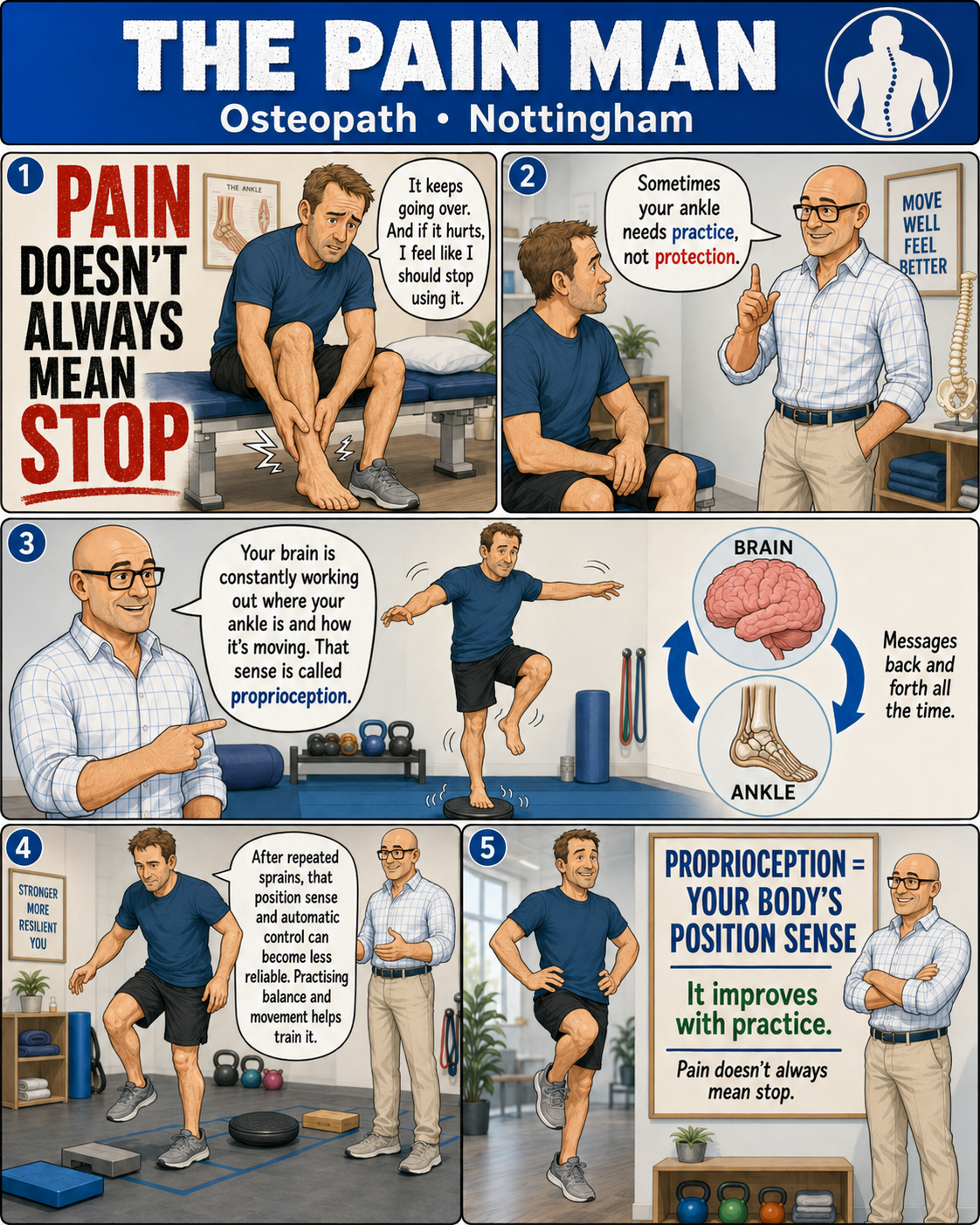
If you’ve sprained the same ankle several times, you may know the feeling.
It isn’t necessarily painful. It might not look swollen. Nobody else can see anything wrong with it.
You just don’t quite trust it.
Perhaps you hesitate on uneven ground. Maybe there’s a moment of uncertainty stepping off a kerb. Or you’re fine most of the time, but somewhere in the back of your mind is the thought: this is the ankle that goes over.
That feeling is worth taking seriously. But it doesn’t necessarily mean your ankle needs to be protected from movement.
Quite often, it needs practice.
A healed ankle isn’t always a confident ankle
After repeated ankle sprains, there can be more going on than whether the ligaments have technically healed.
One of the things that can be affected is proprioception — essentially your brain’s awareness of where a joint is and what it is doing without you having to look at it.
You use this constantly.
When you walk across a slightly uneven pavement, you don’t consciously calculate the angle of your ankle and tell individual muscles when to contract. Your sensory and movement systems are continually making tiny automatic adjustments in the background.
After recurrent ankle sprains, that system can become less reliable. Research into chronic ankle instability — the recurring sense of giving way or instability that can follow ankle sprains — has identified problems with proprioception, postural control and sensorimotor function in at least some people with the condition.
That doesn’t mean there is necessarily a visibly “loose” ankle.
Sometimes the joint can be reasonably stable structurally, but its owner still doesn’t feel completely secure using it.
And that feeling matters.
“I don’t trust it” is useful information
Medicine can sometimes be very keen on things we can measure.
Range of movement: measure it.
Strength: test it.
Swelling: measure that too.
But a patient’s answer to “Do you trust your ankle?” can tell us something important as well.
In fact, the international PAASS framework, developed to guide return-to-sport decisions after ankle sprain, specifically includes perceived ankle confidence, reassurance and stability alongside strength, proprioception, balance and functional performance.
That doesn’t mean confidence is “all in your head”.
Nor does it mean every feeling of instability is caused by one neat little proprioception fault.
Previous injury, sensation, movement control, strength, expectation and experience all interact. In the real world, separating those into tidy boxes can be rather less useful than textbooks make it sound.
The important question becomes:
What does this ankle need to be able to do for you to trust it again?
This is where “practice” comes in
Balance training and rehabilitation aren’t simply tricks for making somebody better at standing on one leg.
They give the nervous system repeated opportunities to sense movement, organise a response and successfully control the ankle.
And there is good evidence behind doing it.
The 2021 clinical practice guideline for lateral ankle sprains recommends proprioceptive and balance-focused exercise as part of reducing the risk of subsequent ankle injury. More recent systematic reviews have also found that balance training can improve dynamic balance and patient-reported function in people with chronic ankle instability.
But here’s the important bit:
the exercise has to lead somewhere.
Train for your life, not somebody else’s
This is why I prefer the phrase life-specific rehabilitation.
If you’re a competitive footballer, standing quietly on one leg in the treatment room is not the end point.
Your ankle eventually needs to cope with running, hopping, landing, accelerating, decelerating, changing direction, reacting to other players and doing all of it while tired and concentrating on something else.
That’s quite a demanding job description.
On the other hand, if you’re 70, have no interest whatsoever in playing five-a-side and simply want to garden, walk the dog and negotiate uneven ground confidently, your rehabilitation may look very different.
Some simple balance work and progressively practising the movements that matter to you may be entirely appropriate.
The aim isn’t to turn everybody into an athlete.
It’s to give your ankle enough capacity for your life.
That is also why a useful rehabilitation programme should progress rather than remain a generic sheet of three exercises handed to everybody with an ankle.
What about ankle braces?
This is where I need to slightly spoil the comic’s punchline.
Braces aren’t useless.
Research suggests that ankle bracing can reduce the risk of repeat sprains, particularly in people doing activities where ankle sprains are common. Systematic reviews have found a meaningful preventative effect, and current clinical guidance includes bracing as one option for reducing recurrence.
So this isn’t an argument that everybody should throw their ankle support in the bin.
If somebody feels safer wearing a brace, and it helps them do something they otherwise wouldn’t do, that may be useful.
But there is an equally important second half to the evidence: a brace shouldn’t be the whole rehabilitation plan.
For people with chronic ankle instability, the clinical practice guideline specifically advises against using braces or taping as a stand-alone treatment to improve balance and postural stability.
A brace can protect.
It cannot practise for you.
From protection towards confidence
There are times when protection is useful. After injury, how much support and loading is appropriate depends on the injury and the stage of recovery.
But once an ankle has been properly assessed, endlessly treating it as something fragile can miss an important part of rehabilitation.
At some point, it has to do things.
Then slightly harder things.
Then the things that matter in that person’s real life.
Those successful experiences help build physical capacity, sensorimotor control and, importantly, trust.
That’s the bigger idea behind the comic.
An ankle that has repeatedly let you down doesn’t always need more guarding. Sometimes it needs the right sort of practice, progressed to the level your life actually asks of it.
For someone with recurrent sprains or repeated episodes of giving way, that progression is best based on a proper assessment rather than simply picking a few balance exercises from the internet. In clinic, that means working out what the ankle can currently do, what you need it to do, and gradually closing the gap.