I don’t Fix People.
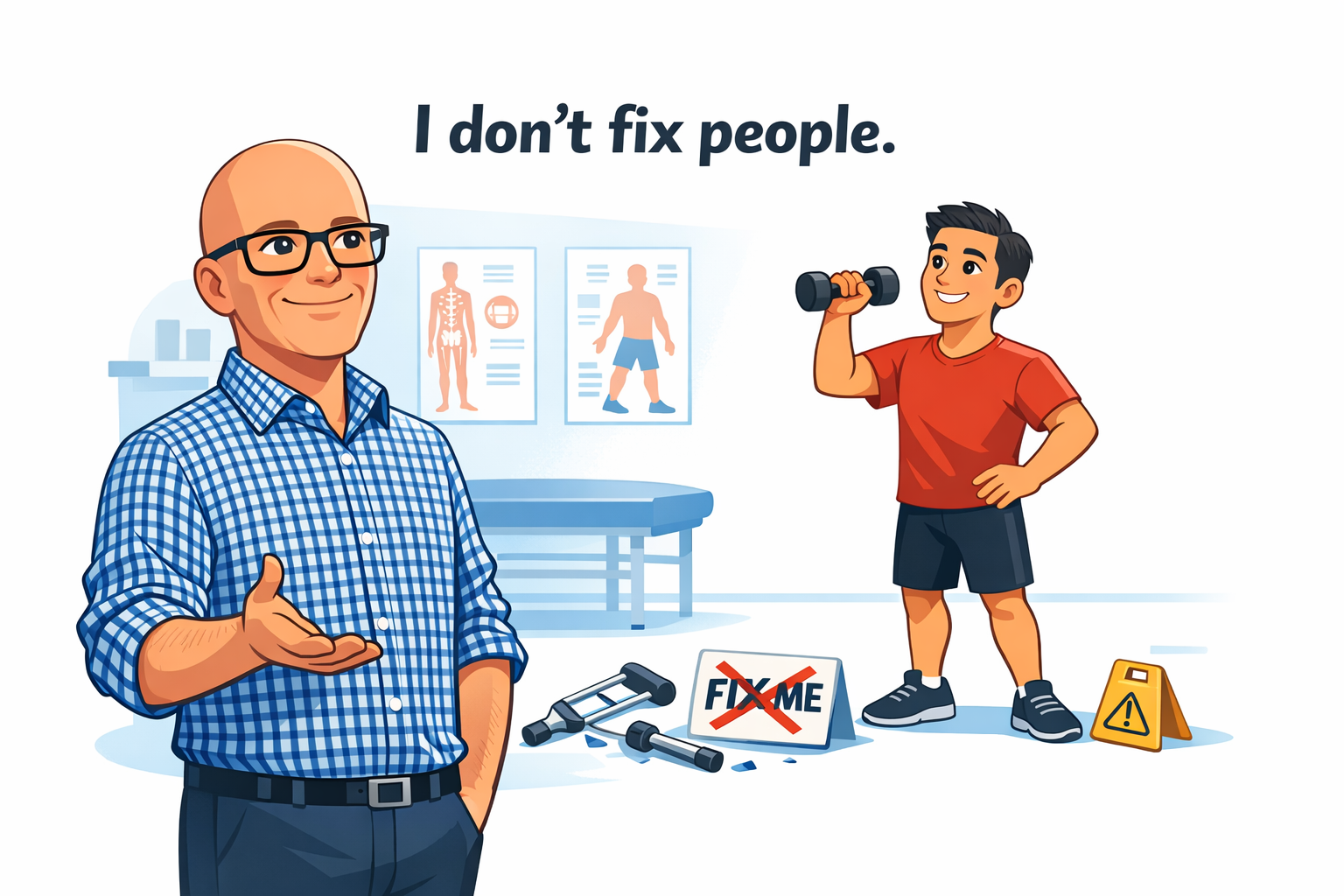
That line sometimes stops people in their tracks.
If you’re coming to see an osteopath, surely the whole point is to be fixed?
But here’s the honest truth: I don’t fix people.
And I don’t want to.
Your body already knows how to heal
In most cases, the human body is remarkably good at repairing itself.
Tissues adapt.
Pain settles.
Strength and confidence can return.
The problem usually isn’t that the body is “broken”. It’s that something is getting in the way of that natural repair process.
That “something” might be:
- A guarded or protective movement pattern
- Fear of bending, lifting, or loading
- A belief that pain equals damage
- A posture you’re forcing yourself into because you’ve been told it’s “correct”
When those blocks are in place, recovery can stall. Not because you’re fragile — but because the system is stuck.
What osteopathy gives me — and why that matters
Osteopathy gives me the freedom to think outside rigid protocols.
I don’t work from one playbook. I take inspiration from:
- Strength and conditioning
- Pain science
- Movement coaching
- Real-world biomechanics
- And, frankly, life experience
If something helps you move better, feel safer, and regain confidence in your body — I’m interested in it.
Sometimes that involves hands-on treatment.
Sometimes it’s changing how you move.
Sometimes it’s challenging an idea that’s been holding you back for years.
There’s no single “osteopathy technique” that fixes everyone — and I wouldn’t trust anyone who claimed there was.
My real job: removing the blocks
I don’t fix people — I help remove obstacles.
Obstacles that might be:
- Over-protection
- Misunderstanding pain
- Loss of confidence in movement
- Habits that made sense once, but no longer help
Once those are addressed, the body often does the rest surprisingly well.
That’s not magic.
That’s how adaptable humans are.
Responsibility matters (and this is where I draw a line)
I can’t — and won’t — take responsibility for fixing you.
What I can do is bring:
- Years of clinical experience
- A modern understanding of pain and recovery
- Clear, honest guidance
- Support while you test and rebuild trust in your body
What you bring is just as important:
- Curiosity
- Willingness to move
- Ownership of your health
This isn’t about blame.
It’s about control.
I don’t want patients who depend on me
This might sound odd coming from someone in private practice, but it matters:
I don’t want you dependent on treatment.
I want you to:
- Understand what’s going on
- Know what helps and what doesn’t
- Feel confident managing flare-ups
- Get back to living your life without fear
If you need support along the way — great.
If you need a reset now and then — that’s normal.
But the end goal is always the same:
you in charge of your body, not me.
In short
I don’t fix people.
I help people:
- Make sense of pain
- Remove the blocks to recovery
- Regain confidence in movement
- Take responsibility for their own health
Because when that happens, most bodies are far more capable than we’ve been led to believe.
Leave a Reply